

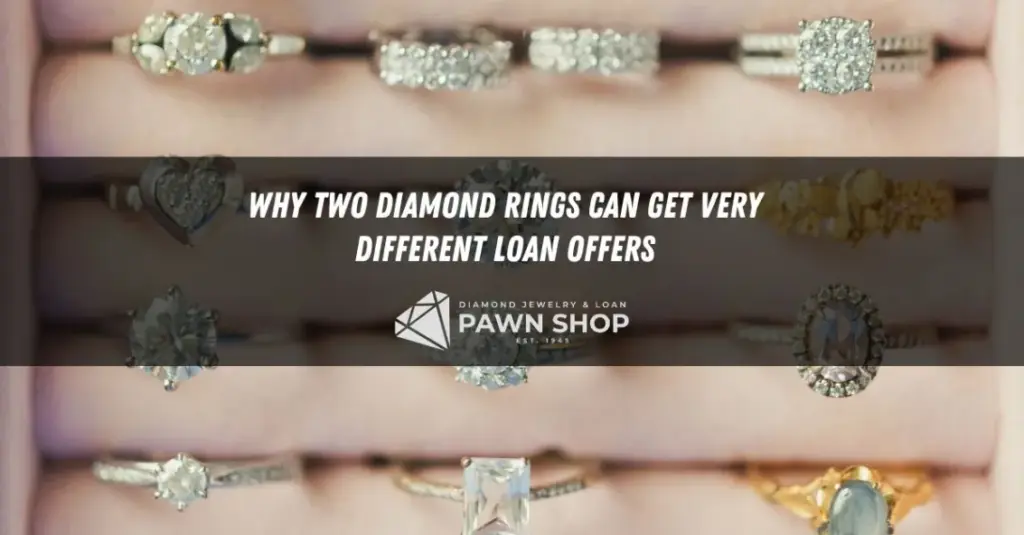
Two diamond rings can look identical but receive very different loan offers because lenders evaluate multiple factors beyond appearance—including cut quality, certification, fluorescence, proportions, condition, metal weight, brand, and current market demand.
You’ve got two diamond rings. Same size. Same sparkle. Side by side, most people couldn’t tell them apart. But bring them to a pawn shop or jewelry lender, and one might fetch a loan offer twice as high as the other.
That gap isn’t random. It reflects a detailed evaluation process that goes far deeper than what the naked eye can see. At Diamond Jewelry and Loan, we’ve been appraising diamonds and precious jewelry in Los Angeles since 1945—and in that time, we’ve seen just about every combination of factors that separates a high-value stone from one that looks the part but doesn’t hold up under scrutiny.
Carat Weight Gets the Attention, but It Doesn’t Tell the Whole Story
Carat weight is the most recognizable diamond metric—and the most misunderstood. Yes, a heavier stone is generally worth more. But carat weight only measures mass, not quality. A 2-carat diamond with poor cut quality and visible inclusions will often appraise lower than a well-executed 1.5-carat stone from a reputable lab.
Lenders don’t just weigh the diamond. They consider carat weight alongside every other factor on this list. Treating carat as a standalone value indicator is one of the most common misconceptions customers bring through our door.
How Cut Quality Affects What Your Diamond Is Worth
Cut quality is arguably the most important factor in determining a diamond’s brilliance—and its resale value. A well-cut diamond reflects light in a way that creates that unmistakable fire and sparkle. A poorly cut stone, even with excellent clarity, can look flat and dull.
The Gemological Institute of America (GIA) grades cut on a scale from Excellent to Poor. When lenders evaluate a diamond, cut grade plays a significant role in determining how desirable the stone would be on the secondary market. An Excellent-cut diamond is far easier to resell than a Fair or Poor cut, which directly influences how much a lender is willing to offer.
Why Certification Can Double the Value of a Diamond
A certified diamond is a documented diamond. Certification from a recognized grading lab—GIA being the gold standard, followed by AGS and IGI—provides an independent, verified assessment of the stone’s characteristics.
Without a certificate, a lender has to rely entirely on their own in-house appraisal. That introduces uncertainty, and uncertainty gets priced into the offer. A GIA-certified 1-carat stone will almost always command a better loan offer than an uncertified stone of the same apparent size, because the certification removes guesswork and confirms what the buyer is actually getting.
If you have your diamond’s certificate, bring it. It can make a meaningful difference.
The Fluorescence Factor Most People Have Never Heard Of
Fluorescence refers to how a diamond reacts under ultraviolet light. Some diamonds glow blue, others show no reaction at all. This might sound like a minor detail, but it significantly affects market value.
Strong blue fluorescence can make a lower-color diamond appear whiter in natural light—which sounds like a benefit. In practice, however, strong fluorescence often gives diamonds a milky or hazy appearance in certain lighting conditions, and many buyers actively avoid it. As a result, strongly fluorescent diamonds tend to sell at a discount on the secondary market, which lenders factor into their offers.
Medium or faint fluorescence generally has little impact. But strong or very strong fluorescence on an otherwise high-quality stone can pull the loan offer down noticeably.
Diamond Proportions: The Hidden Math Behind Sparkle
Separate from GIA’s overall cut grade, diamond proportions—including table percentage, depth percentage, crown angle, and pavilion angle—affect how light moves through the stone. Two diamonds can share the same cut grade but have meaningfully different proportions, leading to very different visual performance.
Experienced appraisers assess proportion data when it’s available, particularly for round brilliant diamonds. Stones with ideal proportions hold their value better and are more attractive to buyers, both of which matter when a lender is determining how much they’re willing to loan against a piece.
Diamond Condition: What Wear and Damage Do to Value
Unlike gold, which can be melted down and recycled regardless of its physical state, diamonds are sold as-is. Chips, scratches on the surface, and damage to the girdle (the diamond’s outer edge) can significantly reduce value—and in some cases, make a stone nearly unloanable.
Even the setting itself matters. A diamond in a damaged or worn prong setting may need costly repair before it can be resold, and that cost gets factored into the offer. Cleaning your jewelry before an appraisal isn’t just cosmetic—a clean stone is easier to assess accurately, which generally works in your favor.
Gold and Platinum Weight: The Metal Matters Too
Diamond rings aren’t just diamonds. The metal they’re set in has its own independent value, and that value fluctuates with commodity markets. A ring set in 18-karat gold or platinum carries more intrinsic metal value than one set in 10-karat gold, regardless of the stone.
At Diamond Jewelry and Loan, we’re one of the largest gold-buying businesses in Los Angeles. We assess the metal component of every piece separately, so customers with heavier or higher-karat settings often see a higher combined loan offer than they might expect—even before the diamond is fully factored in.
Designer Brand: Does the Name on the Ring Matter?
Signed jewelry from recognized designers—Cartier, Tiffany & Co., Van Cleef & Arpels, Harry Winston—carries a premium that generic settings simply don’t. That premium exists because branded pieces have a documented resale market with buyers who specifically seek them out.
If your ring came in its original branded box with paperwork, that documentation adds value. Without it, a lender may still recognize the hallmarks, but provenance matters. A Cartier ring with its original receipt and box will almost always generate a better offer than the same ring without supporting documentation.
How Market Demand Shifts Loan Offers Over Time
Diamond values aren’t static. The secondary market for diamonds responds to broader economic trends, shifts in consumer preferences, and even changes in how diamonds are sourced. The rise of lab-grown diamonds, for example, has put downward pressure on natural diamond prices across some size ranges—particularly in the 1- to 2-carat range where lab-grown stones are now widely available at a fraction of the cost.
Colored diamonds (fancy yellows, pinks, blues) have held their value more robustly in recent years, in part because they’re harder to replicate convincingly in a lab at scale. Current market demand is always part of any honest appraisal, and it can shift the offer meaningfully depending on when you come in.
What to Bring When You’re Ready to Get a Loan on Your Diamond
Walking in prepared makes a real difference. Here’s what to bring:
- GIA or AGS certificate, if you have one
- Original purchase receipt or appraisal documents
- Designer packaging or branded box, for signed jewelry
- Any previous appraisals, even if they’re older
If you don’t have documentation, don’t worry—our appraisers can evaluate the piece independently. But documentation speeds the process and often supports a higher offer.
Making the Right Decision for Your Situation
Two rings. Same look. Very different stories underneath.
At Diamond Jewelry and Loan, we’ve been serving the people of Los Angeles since 1945, and our appraisers have the experience to assess all of these factors accurately and fairly. We’re BBB accredited, fully licensed, bonded, and insured—so you can walk in with confidence knowing you’re working with one of the most established and trusted names in the city.
If you’re considering a collateral loan on your diamond jewelry, visit our diamond loan page to learn more about how the process works, or stop by our Los Angeles location for a free, no-obligation appraisal.